KognitaKognita.
Kognita

For Developers

A semantic layer
for your whole system.

Kognita creates a unified semantic layer around your software system. It understands the purpose of logical units, the relationships between them, and the evidence behind them, then exposes that layer so developers and AI coding tools can search with context from the first message.

semantic layerindexed

logical unit

customer payment confirmation workflow

purpose

turn successful payments into wallet updates and device access

relationships

API → payment processor → wallet journal → token request

agent context

open payment service, wallet model, token tests, and downstream reports

more than naive rag

Kognita understands the system as connected logical units.

Plain RAG usually chunks files, embeds text, and retrieves whatever looks similar. That helps, but it is shallow. Kognita builds a living semantic layer around the system: what each unit is for, how units relate, where behavior flows, which data they touch, and what evidence supports the answer.

Purpose

What this logical unit does for the product or business workflow, expressed beyond filenames and symbols.

Relationships

Callers, callees, data touchpoints, events, jobs, APIs, and downstream consumers connected across repositories.

Evidence

The implementation paths, files, functions, schemas, and tests that support each answer.

Search surface

A queryable layer exposed through Kognita search, managed chat, and MCP for Claude Code, Cursor, Codex, and Windsurf.

basic repository rag

Retrieve similar chunks.

Useful for finding nearby text, but the model still has to infer purpose, trace relationships, identify downstream impact, and rebuild system context inside the chat window.

kognita semantic layer

Query the system model.

Kognita serves relationships, purpose, call paths, schemas, jobs, and implementation evidence as a reusable context layer. Agents start closer to the truth and spend fewer tokens getting oriented.

developer outcomes

Less time rediscovering structure. More time shipping with confidence.

Developers and AI coding tools search the semantic layer instead of starting from zero. Onboarding, debugging, code review, and AI-assisted implementation begin from shared system context rather than a cold prompt and a pile of raw files.

Search logical units, not raw chunks

Ask about workflows, services, jobs, routes, schemas, and business concepts. Kognita maps those units to the code that implements them.

Expose purpose and relationships

Kognita understands why a unit exists, what calls it, what it calls, which data it touches, and which downstream behavior it affects.

Onboard into a system faster

New engineers can pair with AI from day one. They can ask how services, tables, jobs, flows, and business rules fit together before they know which repository to open.

Give AI tools real context

Claude Code, Cursor, Codex, and internal agents can work from grounded system knowledge instead of guessing from a few open files or burning tokens rediscovering the same context.

Debug across boundaries

Trace behavior from endpoint to service to database to background job, with the surrounding business meaning intact.

Save tokens in every chat

Kognita gives assistants the relevant system map up front, so each conversation spends fewer tokens on orientation and more on useful reasoning.

continuous codebase intelligence

Monitor. Learn. Answer.

Kognita tracks the code your team has approved, refreshes the unified semantic layer as it changes, and exposes that context to the tools developers already use. The result is a codebase agent that keeps up with the real implementation instead of drifting into stale assumptions.

Beyond basic RAG, Kognita learns purpose and relationships across services, routes, jobs, schemas, dependencies, and business rules. Developers get answers that can point back to system evidence, not just nearby text matches.

Every AI coding session starts with more of the right context up front, so Claude Code, Cursor, Codex, and other agents spend fewer tokens rediscovering architecture and more of their budget reasoning about the change.

01

Monitor authorized repositories, branches, and code changes as the system evolves.

02

Extract logical units and learn their purpose, relationships, call paths, schemas, jobs, dependencies, and business intent.

03

Expose that semantic layer through search, MCP, Claude Code, Cursor, Codex, Windsurf, and the managed Kognita chat.

04

Keep every AI coding session grounded without paying the same token tax repeatedly or forcing the model to start from zero.

onboarding

Ask AI how the system works before opening the first pull request.

token efficiency

Spend fewer tokens rediscovering files, dependencies, naming, and product intent.

better first answers

Start each chat with grounded context from the semantic layer instead of a blank slate.

call graph database

Your code becomes a call graph: methods, callers, downstream services, and database touches become queryable context

The semantic layer is not a pile of file chunks. It is a connected map of how the system behaves, so developers and agents can traverse real implementation paths.

◆ fully mapped

Each function, import, service call, Kafka event, and table reference becomes a connected node in the system map.

◆ instant traversal

Developers and AI tools can follow real call paths instead of guessing which repository, service, or table matters.

Everyagent starts with system context

supported languages

JavaScriptTypeScriptPythonJavaC#GoRustRubyPHPHCL / Terraform

for developers

Plug your dev tools into the same system layer.

Skip the bespoke RAG pipeline. Kognita exposes your repositories as a dedicated MCP-native semantic graph: call sites, routes, jobs, schemas, database touchpoints, and prose intent queryable from Claude Code, Cursor, Codex, Windsurf, and internal agents.

The project MCP unlocks after at least one repository is indexed. Your tools connect with SSE, a bearer token, and the same semantic search layer used by the managed Kognita chat.

Claude Code
terminal
$ claude mcp add-json kognita-mcp '{"type":"http","url":"https://mcp.kognita.co/projects/<project-uuid>/mcp","headers":{"Authorization":"Bearer <your-token>"}}'
Cursor / mcp.json
.cursor/mcp.json
{
  "mcpServers": {
    "kognita-mcp": {
      "type": "http",
      "url": "https://mcp.kognita.co/projects/<project-uuid>/mcp",
      "headers": {
        "Authorization": "Bearer <your-token>"
      }
    }
  }
}
Codex / config.yaml
~/.codex/config.yaml
mcp_servers:
  kognita:
    type: http
    url: https://mcp.kognita.co/projects/<project-uuid>/mcp
    headers:
      Authorization: "Bearer <your-token>"

Also works with Windsurf, Zed, Continue, and any other MCP-compatible client.

developer reading

Deeper reads on context, token cost, and tool limits.

These posts explain the same problem from different angles: Cursor, Claude Code, Context+, Greptile, MCP, context windows, and token cost all hit the same ceiling when agents do not have a shared semantic model of the system.

token cost11 min

Your Multi-Agent Coding Setup Is Spending $8 Per Developer Per Hour. Nobody Knows What It's Reading.

Why agentic coding spend compounds when agents keep rereading raw context.

Read article
context cost10 min

MCP Tool Definitions Are Eating 26% of Your Agent's Context Window Before It Starts

How naive MCP tool definitions consume the context window before real work starts.

Read article
context rot11 min

What Is Context Rot — And Why It Makes Your AI Coding Tool Dumber Over Time

Why long AI coding sessions degrade and need a persistent semantic anchor.

Read article
context windows15 min

Why Context Windows Will Never Be Enough

Why bigger windows still do not replace system structure and relationship maps.

Read article
cursor10 min

Cursor vs Kognita: Individual Developer Speed vs Whole-Team System Legibility

Where Cursor helps individual developers and where shared system context still matters.

Read article
cursor / claude10 min

Why Cursor and Claude Code Still Fail in Large Repositories

Why large repositories break local context and require execution-aware retrieval.

Read article
context+13 min

Kognita vs ContextPlus: Managed Codebase Context for the Whole Team

How managed codebase context differs from local developer context tooling.

Read article
greptile11 min

Greptile vs Kognita: Codebase Search for Developers vs System Understanding for Everyone

The difference between developer codebase search and whole-team system understanding.

Read article
better context13 min

How to Give Your AI Coding Tools Better Codebase Context

A practical ladder from static context files to semantic MCP for the whole team.

Read article

context from the first message

Stop making AI rediscover your architecture.

Standard assistants inspect files one by one and still miss business flow, ownership, and downstream relationships. Kognita gives them a maintained semantic layer before they start reading.

without kognita
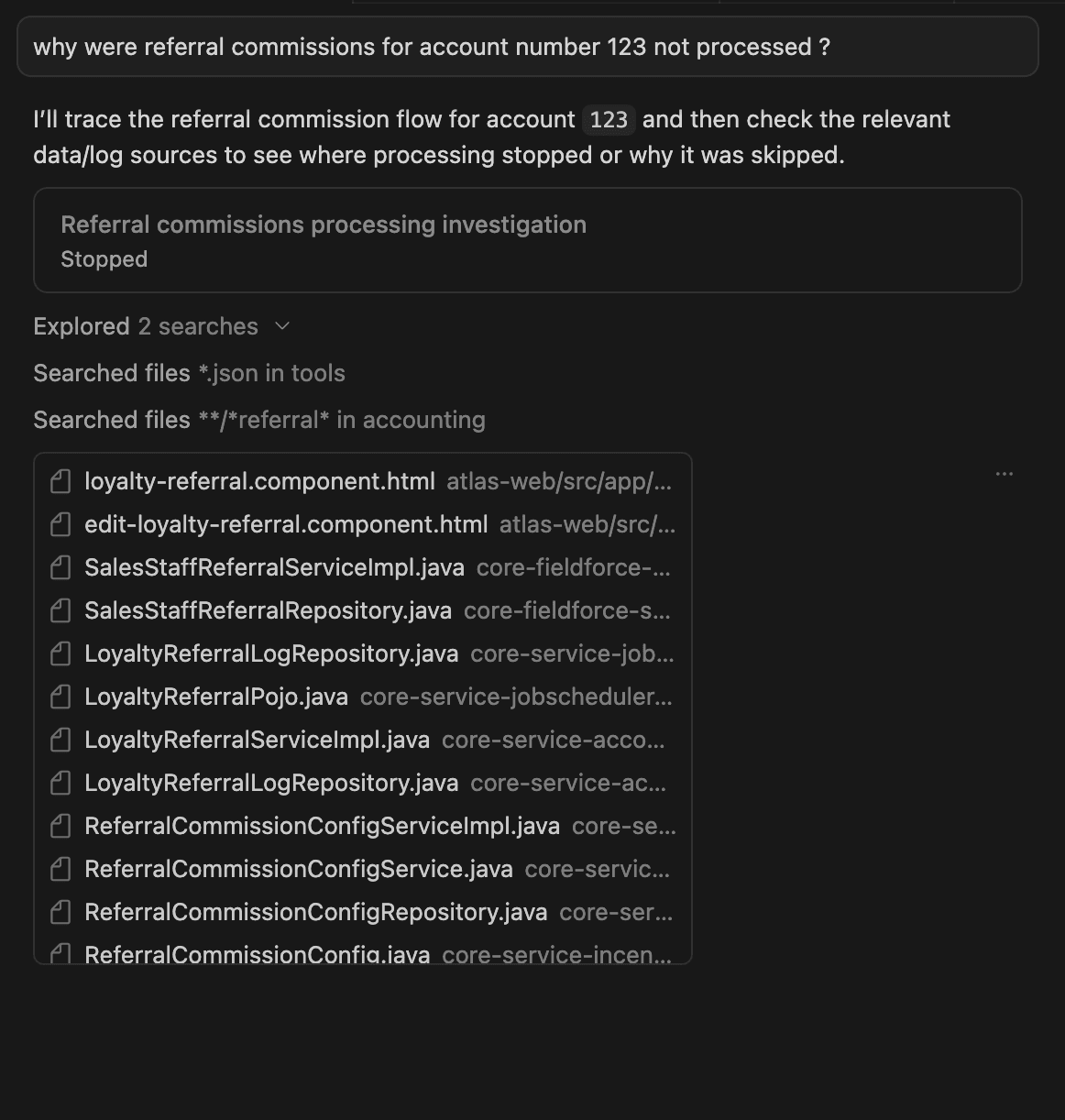
AI session without Kognita wandering through code

The assistant spends its budget orienting itself: opening nearby files, missing indirect dependencies, and asking the developer to explain the domain.

with kognita
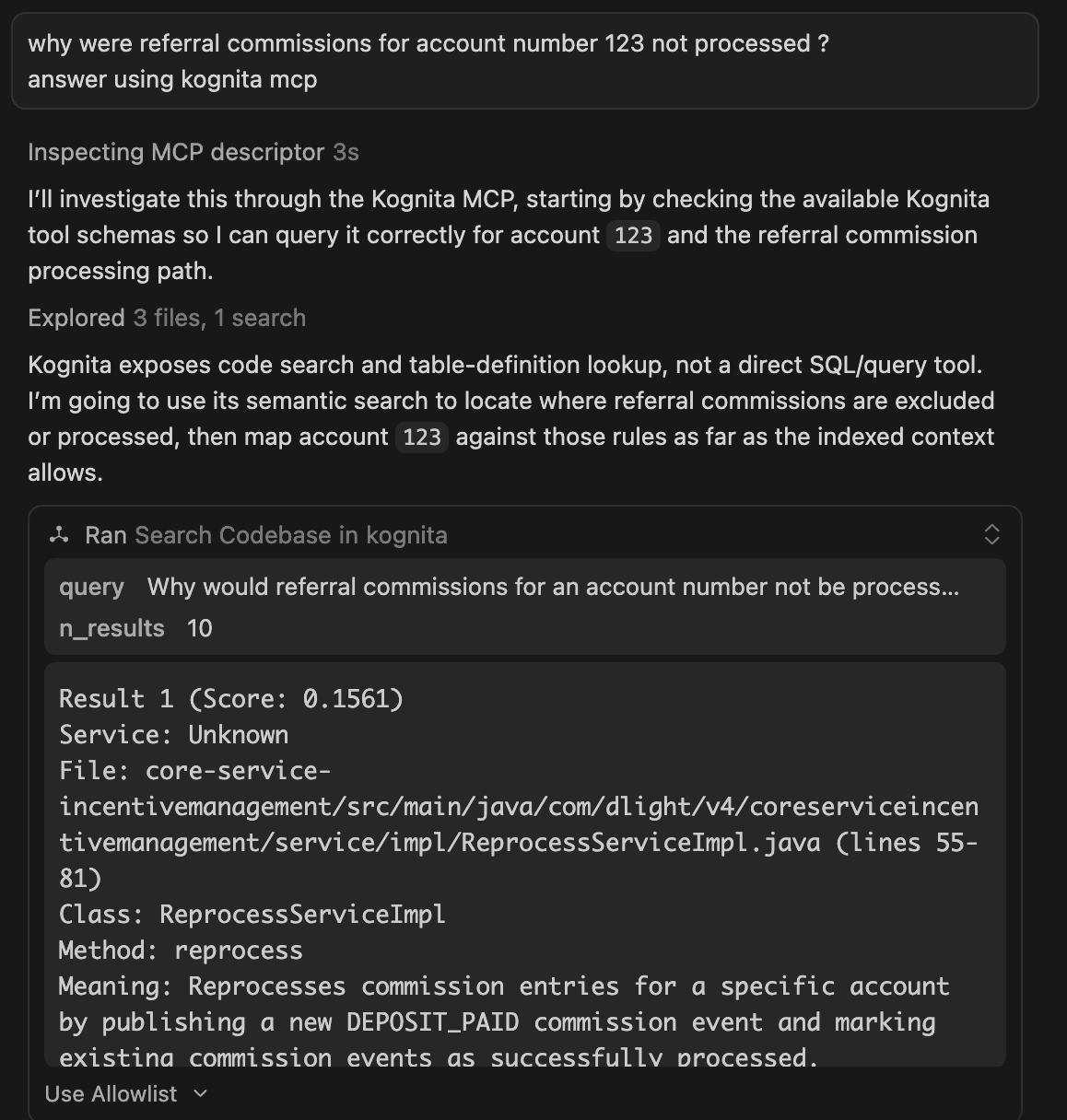
AI session with Kognita using retrieved system context

The assistant starts from retrieved logical units, purpose, relationships, tables, call paths, and plain-language meaning, then uses the repository only when it needs deeper evidence.

developer faq

Unified semantic code intelligence for AI-assisted engineering.

The questions developers ask are usually about context: where behavior lives, what purpose it serves, what depends on it, and what an AI agent needs to know before touching code.

01

How does Kognita help developers using Claude Code, Cursor, Codex, or Windsurf?

Kognita gives AI coding tools a maintained semantic layer through MCP, so agents can retrieve relevant services, functions, routes, schemas, dependencies, and business logic before they plan or edit. The model starts from a system map instead of a blank prompt and spends fewer tokens rediscovering architecture.

02

Is Kognita just code search or repository RAG?

No. Traditional code search finds files or text matches. Basic RAG chunks files and embeds them. Kognita builds a unified semantic layer: logical units, their purpose, their relationships, call paths, database touchpoints, operational meaning, cross-repository context, and evidence that an AI tool or developer can follow.

03

Why do AI coding agents need semantic code intelligence?

AI coding agents often work from a narrow local view: open files, nearby references, and whatever the developer explains in the prompt. In a real production system, the important context may live in another service, migration, job, queue, database table, or ticket. Kognita gives the agent system-level context before it guesses.

04

Does Kognita save tokens in AI coding sessions?

Yes. Kognita reduces repeated orientation work by giving the model relevant codebase context up front. Instead of spending every session reopening files, tracing dependencies, and asking the developer to explain the system, the agent can start from a focused system map and use its context window for reasoning.

05

Can Kognita help with onboarding engineers into a large codebase?

Yes. New engineers can ask how workflows, services, tables, background jobs, and business rules fit together before they know which repository or file to open. That shortens the path from first day to useful pull request, especially in monorepos and multi-service systems.

06

How does Kognita work with multi-repo and microservice architectures?

Kognita can index related repositories into a shared project so developers and AI tools can ask cross-service questions. It helps trace behavior across APIs, jobs, data models, queues, shared packages, and downstream consumers instead of treating each repo as an isolated island.

07

Will Kognita replace IDE tools or AI coding assistants?

No. Kognita complements IDE tools and AI coding assistants. Cursor, Claude Code, Codex, Windsurf, and similar tools help generate and edit code; Kognita provides the system context layer that makes those tools less likely to work from incomplete assumptions.

for developers

Give your AI coding tools a semantic layer, not another pile of chunks.

Connect the repo once and query a unified system model from Claude Code, Cursor, and Codex. Kognita understands logical units, purpose, relationships, and evidence so agents do not start from zero.